If you're a student from Kerala weighing up the UK and Germany, you're comparing two very different options. One is famous for short, fully English courses and well-known universities. The other is famous for low tuition and a strong technical reputation. Both are popular with Indian students, and both can be a great choice. The question is which one fits you.
This guide covers the basics in plain language. It focuses on studying: course length, cost, language, how to apply and what to expect. It's written in November 2026, and rules and fees change, so always check official sources. If you'd like advice for your own situation, Cliftons Study Abroad is happy to help.
The Short Answer
There's no single winner. The UK is often better if you want a short course, full English teaching and a wide range of universities and subjects. Germany is often better if you want to keep tuition low, you're interested in technical or scientific subjects, and you're comfortable with more paperwork and perhaps learning some German. Let's look at the details.
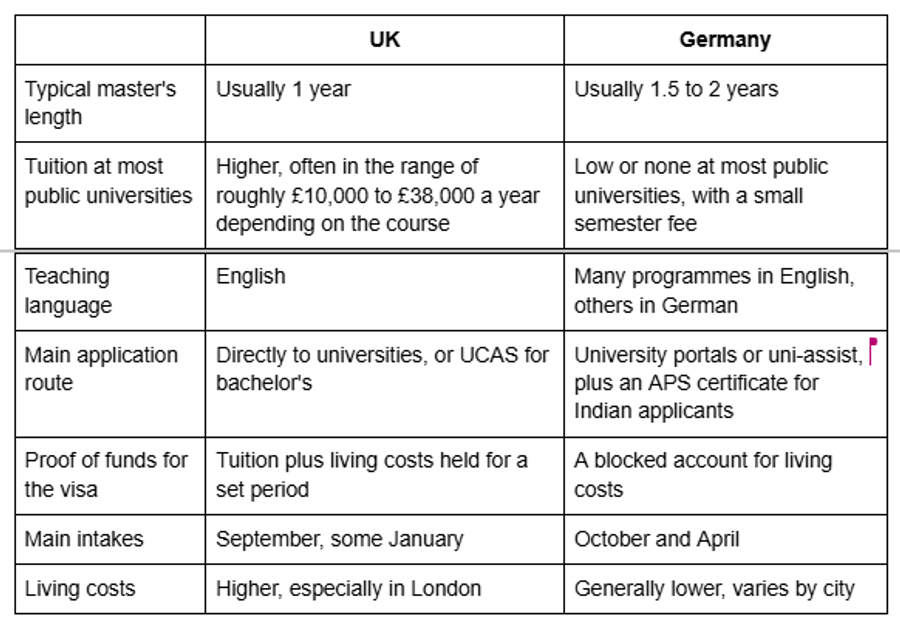
The Basics Side by Side
Treat this as a starting point, since details vary by university and course.
Course Length and Structure
The UK is known for speed. Most taught master's degrees last just one year, and many bachelor's degrees take three. That means less time away from home and fewer months of living costs.
Germany's master's degrees usually take around two years, sometimes a little less. They tend to go deeper into theory and often include a research project or thesis, which many students find valuable, especially in engineering and science.
Neither is "better." A one-year course is intense and efficient. A two-year course gives more time to learn and to adjust. Which feels right depends on you.
Cost: Where the Biggest Difference Lies
Tuition is where the two countries differ most.
UK: International students pay tuition set by each university. Fees vary widely by subject and university, and courses such as business, MBA and medicine can cost much more. Living costs are also higher, especially in London, so many students look at other cities.
Germany: Most public universities charge no tuition for master's courses, only a semester contribution of a few hundred euros. There are exceptions, since a couple of states and universities charge non-EU students, so always check. Private universities charge fees.
But don't stop at tuition. In Germany, you must show proof of funds through a blocked account for your visa, with recent sources putting the amount at around €11,900 for a year. It's your own money and is released to you monthly for living costs, but you need to have it ready upfront. In the UK, you must show you can pay your tuition plus living costs. See our basics guide to education loans for studying abroad if you're thinking about funding.
For a fair comparison, think about total cost, including living costs, insurance and travel over the whole length of your course.
Language: English Everywhere or a Bit More Complicated
The UK is straightforward, since courses are taught in English and you'll need to prove your English with an approved test. See our guide to IELTS vs PTE vs TOEFL, and note that UK visas need an approved test version.
In Germany, many master's programmes are taught in English, but not all. You'll need to check each course, and you may also need to prove English. Even if your course is in English, knowing some German makes daily life, part-time work and settling in much easier. At bachelor's level, German is more commonly required.
Applying: Two Different Processes
UK: Most master's applications go directly to the university, often online, with a statement of purpose, references and transcripts. Bachelor's applications usually go through UCAS. Once you accept an offer, you get a CAS, then apply for the visa.
Germany: The process involves more steps. Indian applicants generally need an APS certificate, which verifies your academic documents before you apply. Applications go directly to the university or through a service such as uni-assist. After admission, you'll open a blocked account and apply for a national visa. Some of these steps take weeks, so start early.
If you prefer a simpler process, the UK may feel easier. If you don't mind the extra steps for lower tuition, Germany can be worth it.
Universities and Subjects
The UK has a huge range of universities, including several in the global top rankings, and almost every subject is available. See our guide to the best universities in the UK for Indian students.
Germany's strengths lie in engineering, technology, natural sciences and many applied fields, with strong technical universities and research institutes. See our guide to a master's in Germany for Indian students and our post on studying engineering in Germany.
If you're a business or management student, the UK has a lot of choice. Our guide to business management courses in the UK covers the basics. If your field is technical, Germany deserves a serious look.
Work During Your Studies
Both countries allow student visa holders to work part-time within limits during their studies. The details differ, and in both cases your studies should come first, so check the rules for your visa.
A Quick Note on Life After Your Studies
Both countries offer a period to stay on after graduation. The UK's Graduate Route is changing from two years to 18 months for applications from 1 January 2027, and Germany offers an 18-month permit to look for work related to your degree. Rules change, so check official sources, and remember that these are routes to look for work, not guarantees.
Who Suits Which Country?
The UK may suit you if:
- You want a one-year master's
- You prefer studying entirely in English
- You want a very wide choice of courses and universities
- You'd like a simpler application process
- You can manage higher tuition
Germany may suit you if:
- You want to keep tuition low
- You're interested in engineering, technology or science
- You don't mind a two-year course and more paperwork
- You're willing to learn some German
- You'd like a research-oriented education
How to Choose: Five Simple Questions
1. What's your budget? Compare the total cost for the whole course, including living costs.
2. What do you want to study? Check that the specific course exists and suits you in each country.
3. How do you feel about language? Decide whether English-only matters to you.
4. How long do you want to study? One year or two.
5. How comfortable are you with paperwork? Germany's process has more steps.
And always check your own academic profile. Many Indian degrees are three years long, and acceptance varies by country and university.
Mistakes to Avoid
- Choosing only on tuition. Include living costs, insurance and travel.
- Assuming Germany is completely free. Semester fees apply, the blocked account is needed, and a few exceptions charge tuition.
- Ignoring the language question. Check each Germany course's teaching language.
- Starting the German process too late. APS and the blocked account take time.
- Using outdated information. Fees, funds requirements and visa rules change often. Our guide to common student visa rejection reasons explains why preparation matters.
- Picking a country before a course. Let the course lead.
Need More Than the Basics? Talk to Cliftons Study Abroad
This guide only covers the basics. Deciding between the UK and Germany depends on your course, your marks, your budget, your language skills and how much paperwork you're comfortable with. A wrong choice can cost time and money. Which country suits your profile, which universities are realistic, and how to plan your timeline are all things a counsellor can help you work out.
At Cliftons Study Abroad in Kochi, we help students across Kerala compare countries, shortlist courses and universities, and manage applications and visas. If you'd like personal guidance, our counsellors are ready to help.
Can't decide between the UK and Germany? [Contact Cliftons Study Abroad today for a free consultation.]