If you're planning to study in the UK, you may have heard people talking about "RAG ratings," "Red, Amber and Green universities" or "the new UKVI rules." Some of it sounds alarming. Some of it is shared on social media or by agents in a way that's confusing or simply wrong.
Here's the calm version. In June 2026, the UK Home Office introduced a new compliance system for universities that sponsor international students. It uses red, amber and green ratings. It affects universities directly, and it affects students indirectly, mostly in how carefully universities handle applications. It doesn't stop you from studying in the UK, and it isn't a ranking of how good a university is.
This guide explains what the system is, how it works, what it means for applicants from Kerala and the rest of India, and what you can do to make a strong, safe application. It's written in November 2026. UK rules change often, so always confirm details on official sources. If you'd like advice for your own situation, Cliftons Study Abroad is happy to help.
The Quick Answer
- What is it? A rating system, introduced by UK Visas and Immigration (UKVI) on 1 June 2026, that rates universities and other licensed student sponsors as Red, Amber or Green.
- What does it measure? Three things: the university's visa refusal rate, its enrolment rate, and its course completion rate.
- Who does it apply to? Universities and colleges that hold a licence to sponsor international students, not to individual students.
- Is it an academic ranking? No. It's a compliance measure.
- Does it change my own visa requirements? Not directly. But it makes universities more careful about who they issue a Confirmation of Acceptance for Studies (CAS) to.
Why the System Was Introduced
The UK Government's Immigration White Paper, published in May 2025, set out a tougher approach to sponsorship, treating a sponsor licence as something institutions must keep earning. The government said it wanted to tighten the rules for universities that recruit international students. The new system, which began on 1 June 2026, replaces the old way of judging compliance with tighter limits and clearer consequences. The UK Council for International Student Affairs (UKCISA) has described the changes as a significant shift in how student sponsors are assessed.
First, What Is the BCA?
Every UK university or college that sponsors international students is checked through something called the Basic Compliance Assessment (BCA). Think of it as a yearly compliance report card. It looks at three questions:
- Visa refusals: Of the students the university sponsors, how many have their visa applications refused?
- Enrolment: Of the students who get a CAS and a visa, how many actually enrol?
- Course completion: Of the students who enrol, how many complete their course?
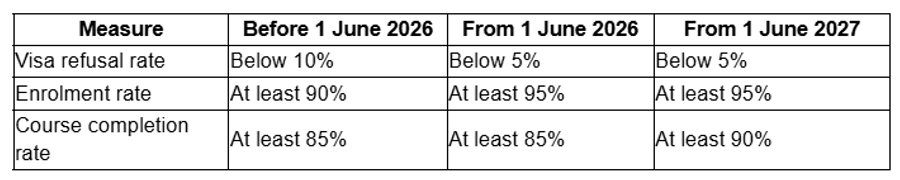
The thresholds were tightened on 1 June 2026. Here's how they compare, according to law firm and sector summaries of the Home Office guidance.
Then Came the RAG Rating
On top of the pass-or-fail BCA, the Home Office added a Red-Amber-Green rating. It sorts every sponsor into one of three bands for each measure. According to sector reporting, the bands work like this.

A university's overall rating isn't an average. It's set by its weakest measure. So a university with brilliant enrolment and completion figures can still be rated Red if its visa refusal rate is too high. Sector commentators have called Amber less a buffer zone and more a warning ledge, because the bands are narrow.
One more detail: only refusals that are later overturned on administrative review are excluded from the refusal calculation. In other words, every other refused application counts against the university.
What Each Rating Means for a University
Green. The university is meeting the strictest standards. Green doesn't automatically bring more CAS allocation, but it avoids the restrictions below.
Amber. The university is close to the limit. Reporting on the guidance says it must attend formal meetings with UKVI to review its results, and it can't be granted more CAS than it used previously until it's rated Green. Some websites describe this as a complete "freeze" on CAS. That goes further than the sources I could verify, so treat that wording with caution.
Red. The most serious band. Reported consequences include being placed on a UKVI action plan, a reduction of at least 10% to the next CAS allocation (with no stated upper limit), and losing some privileges such as assessing students' English language ability itself or delivering teaching remotely. Sector analysis also describes a "final warning" period, during which another Red rating could put the sponsor licence at risk.
Note that these consequences fall on the institution. The system regulates how many CAS letters a university can issue. It doesn't ban students from the UK.
What This Means for You as an Applicant
For most students, the effect is felt indirectly. Here are the realistic ways it may touch your application.
1. Universities may check applications more carefully. Since every refusal counts against them, universities have strong reasons to make sure applicants are well prepared and genuinely intend to study. You may notice more detailed questions about your finances, your English, and your reasons for choosing the course.
2. Some universities may become more selective. A university that's near a threshold might be cautious about issuing CAS letters, particularly where it sees higher risk. This isn't a judgement of you personally, but it does mean weak or unclear applications are less likely to succeed.
3. Timing can matter. If a university's CAS allocation is restricted, places may run out sooner. Applying early gives you a better chance.
4. Agents are under more scrutiny. The Home Office now records whether an agent was involved in a CAS assignment, according to law firm summaries. Universities are therefore paying close attention to the quality of applications that come through agents. This is another reason to work with an adviser who prepares honest, well-documented applications and never promises guarantees.
5. Your own behaviour counts too. Enrolling on time and staying on your course are part of what the university is measured on. This isn't about pressure, but it does mean you should plan realistically and talk to your university early if something goes wrong, such as a delayed visa.
What You Can Do: A Practical Checklist
- Choose a course that fits your background. A clear link between your past studies and your chosen course makes your application more convincing.
- Prepare honest, consistent documents. Marks, certificates, finances, and statements should all match. Our guide to common student visa rejection reasons explains the most common pitfalls.
- Show clear funds. Have your financial evidence organised, with a documented source and history. If you're planning to borrow, our basics guide to education loans for studying abroad is a good place to start.
- Meet the English requirement properly. The UK visa needs an approved test version. See our guide to IELTS vs PTE vs TOEFL.
- Write your own statement. Generic or copied statements raise doubts.
- Respond quickly. If your university asks for more information, reply promptly and honestly.
- Apply early. Don't leave it until the last weeks before your intake.
- Plan to enrol on time. If something delays your visa or arrival, contact your university's international office early.
- Never use fake or altered documents. They can end your application and your future options.
Myths and Facts
Myth: Red-rated universities can't accept international students. Fact: They can, but their CAS allocation is reduced, and they face restrictions. They may become more selective.
Myth: A RAG rating is a quality ranking. Fact: It measures compliance with immigration rules, not teaching or research quality. A great university can be rated Amber, and a modest one can be Green.
Myth: Amber means no new CAS letters at all. Fact: Reporting on the guidance says Amber sponsors can't be granted more CAS than they previously used, and must attend formal meetings. Some websites go further than that, so check official guidance.
Myth: You can look up a university's official RAG rating today. Fact: Sector reports say ratings are held by the Home Office for now, with public ratings expected later, reportedly from 2027. Any website claiming to show official Green, Amber or Red lists should be treated with great care.
Myth: Only the student suffers if a visa is refused. Fact: Refusals also count against the university's rating, which is why universities now care so much about application quality.
Myth: An agent can guarantee your visa. Fact: No one can. Be wary of anyone who says they can.
How to Check a University Properly
Because official RAG ratings haven't been made public, here's what you can do right now.
1. Check that the university holds a student sponsor licence. The UK Government publishes the Register of Licensed Sponsors (Students) on GOV.UK. If a university isn't on it, you can't get a Student visa to study there.
2. Ask the university directly. The international admissions or student office can tell you about intake, offers, and any changes in how they process applications.
3. Be careful with unofficial websites. Several third-party sites, including some that use "UKVI RAG" in their name, publish band information or university lists. The website that prompted this article states clearly that it is an independent service, that it isn't affiliated with UKVI, the Home Office or GOV.UK, and that its band data isn't an official publication. Use such sites for general explanations at most, and don't base a decision, or a deposit, on a university's supposed colour.
4. Choose the course and university first. Rating or no rating, the best university is still the one that fits your course, budget and goals. Our guide to how to choose the right university abroad shows how to build a balanced shortlist, and our guide to the best universities in the UK for Indian students explains how to read rankings.
Key Dates to Know
- 12 May 2025: The UK Government publishes its Immigration White Paper, announcing tougher sponsor compliance rules.
- 1 June 2026: The tightened BCA thresholds and the RAG rating system take effect.
- 1 June 2027: The minimum course completion requirement rises from 85% to 90%.
- From 2027 (reported): Public ratings are expected to appear once sponsors have been assessed. Check the official register for updates.
What This Doesn't Change
It's worth remembering what stays the same. The UK is still welcoming international students, and the core visa requirements still apply: an offer and CAS from a licensed sponsor, an approved English test, proof of funds and the usual checks. The Graduate Route is also changing to 18 months for applications from 1 January 2027, which is a separate change. If you're comparing destinations, see our guides to UK vs Germany and UK vs Ireland.
Frequently Asked Questions
What does RAG stand for in UKVI?
Red, Amber, Green. It's the colour-coded rating UKVI gives to licensed student sponsors based on visa refusals, enrolment and course completion.
Is the RAG system the same as the BCA?
Not exactly. The BCA is the annual pass-or-fail compliance check. The RAG rating adds colour bands on top of it, with sharper consequences.
Will a Red university refuse me automatically?
No. But it may be more selective, because it has fewer CAS letters to give.
Can I check my university's RAG rating?
Not officially yet. Be wary of unofficial websites. You can check the GOV.UK sponsor register to confirm a university is licensed.
Does RAG affect my visa application directly?
Not directly. It affects how universities handle applications and CAS issuance.
Should I avoid Amber or Red universities?
Not automatically. Ratings can change, and they say nothing about academic quality. Focus on your course, your profile and honest, well-prepared documents. Ask a counsellor if you're unsure.
Need Guidance? Talk to Cliftons Study Abroad
The UK's compliance rules are changing, and it's easy to get lost in conflicting advice online. Which UK universities suit your profile, how to prepare a strong application, and how to plan your timeline are things a counsellor can help you work out.
At Cliftons Study Abroad in Kochi, we help students across Kerala compare countries, shortlist courses and universities, and manage applications and visas. We prepare honest, well-documented applications and never promise guaranteed outcomes. If you'd like personal guidance, our counsellors are ready to help.
Planning to study in the UK? [Contact Cliftons Study Abroad today for a free consultation.]