Ask a group of Kerala students why they're looking at the UK for their master's, and one answer comes up again and again: "It's only one year."
That single fact shapes a lot of decisions. A shorter degree means less time away from home, fewer months of living costs and an earlier return to work or further study. But the one-year format isn't just about speed. It also affects how you study, what the course feels like and who it suits best.
This guide covers the basics in plain language: why the UK is so popular for one-year master's degrees, what the format involves, and the honest points to consider before you apply. It's written in November 2026, and fees and rules change, so always check official sources. If you'd like advice for your own situation, Cliftons Study Abroad is happy to help.
What Does a One-Year UK Master's Actually Look Like?
Most taught master's courses in the UK, such as an MSc, MA or MBA, are designed to be completed in about 12 months of full-time study. A typical pattern looks like this:
- Autumn and spring terms: taught modules, with lectures, seminars, labs, group work and assessments
- Summer: a dissertation or major project, often the biggest piece of work in the degree
- Overall workload: usually around 180 credits at master's level, though this varies by course
Not every course follows this exactly. Some are longer, such as those with a placement year, and some are shorter. But for most taught master's degrees, one year is the norm.
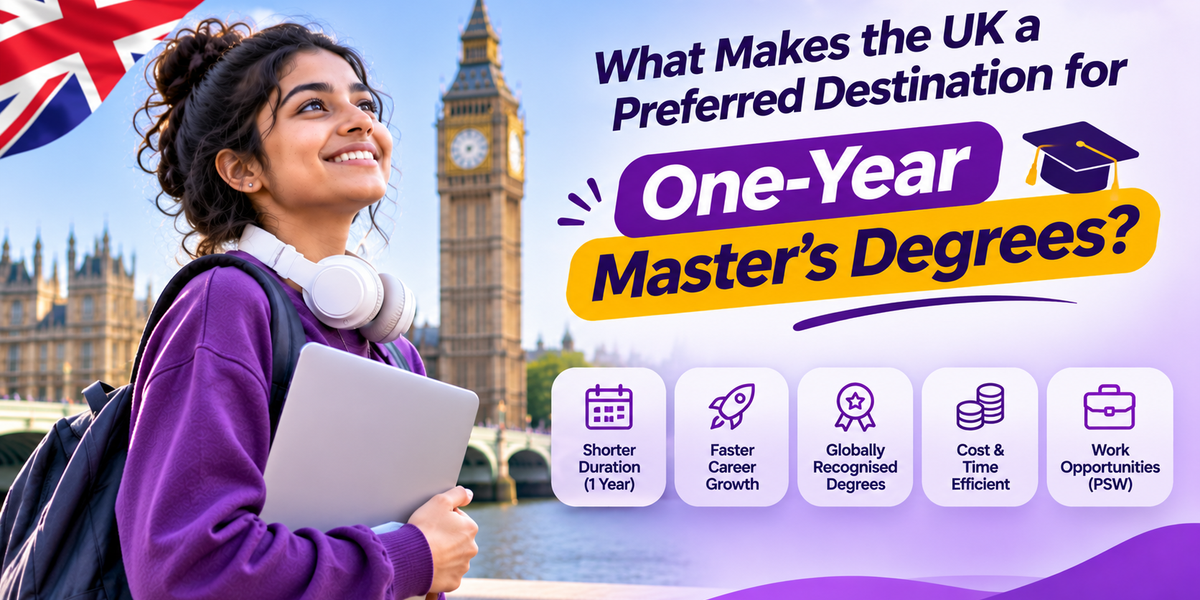
Reason 1: You Save Time
This is the most obvious benefit. Where some countries expect two years for a master's, many UK courses take one. That means you finish sooner, which can matter if you want to move into the next phase of your life, whether that's further study, a career or going home.
For students who already have a clear direction, a focused year can feel more efficient than a longer programme.
Reason 2: You Save on Living Costs
Tuition in the UK can be high, and we'll be honest about that below. But living costs add up month by month, and a one-year course means fewer months of rent, food and transport. When you compare total costs, not just tuition, the picture often looks more balanced. A year in a cheaper city can be significantly more affordable than a year in London.
Compare your own numbers, including tuition, rent, food, travel, insurance and visa costs, rather than relying on general claims. If you're planning to borrow, our basics guide to education loans for studying abroad is a good place to start.
Reason 3: A Huge Choice of Universities and Courses
The UK has well over a hundred universities, and almost every subject has a one-year master's option. That includes business, finance, data science, engineering, computing, law, healthcare, creative subjects, social sciences and more.
This range matters. If your interest is niche, the UK is more likely to have a course that matches it than a smaller system. Our guides to business management courses in the UK, cybersecurity courses in the UK, pharmacy courses in the UK and physiotherapy courses in the UK show how varied it can get.
Reason 4: A Globally Recognised Qualification
UK degrees are recognised and respected around the world, and the UK has a strong presence in global university rankings. In the QS 2027 edition, more than a dozen UK universities sit in the world top 100. Rankings aren't everything, and our guide to the best universities in the UK for Indian students explains how to read them, but they show that quality is available at many levels of the system.
Reason 5: Intensive, Focused Learning
One-year courses are fast-paced by design. There's little repetition, and content is taught in a concentrated way. Many students like this because:
- You go straight into advanced material
- Assessments are spread across the year, so you keep working steadily
- The dissertation lets you explore a topic in real depth
- You can apply what you learn quickly through projects and case studies
If you enjoy being challenged, this can be exciting.
Reason 6: Strong Support Systems for International Students
UK universities are used to welcoming students from all over the world. Most offer orientation programmes, international student offices, accommodation guidance, academic skills support, English language support and wellbeing services. Because one-year courses move quickly, good support at the start matters, and many universities are set up to provide it.
Support varies between universities, so it's worth looking at what each one offers. Our guide to how to choose the right university abroad covers what to check.
Reason 7: Clear Intakes and a Familiar Structure
Most UK master's courses start in September, and some universities also offer January or other intakes for certain courses. The academic year is predictable, and a September start means you can plan around well-known timelines for applications, offers and visas.
Reason 8: Teaching in English
For students from Kerala, studying entirely in English removes the language barrier that exists in some destinations. You'll need to prove your English, and the UK visa requires an approved test version, so check carefully. See our guide to IELTS vs PTE vs TOEFL. Once you're there, you'll be learning and living in English, which many students value.
An Honest Look: Is It Right for Everyone?
A one-year master's isn't automatically the best choice for every student. Think carefully about these points.
It's intense. There's less time to settle in, adjust to a new education system and recover from a slow start. If you struggle in the first term, the year goes fast.
Tuition can be high. UK fees are often higher than in some other destinations, and they vary widely by university and course. The shorter length helps, but you still need a realistic budget. Our guides to UK vs Germany and UK vs Ireland compare costs and course lengths.
Less time to explore. A two-year programme can include more time for internships, travel and settling in. A one-year course leaves less room.
Entry can be competitive. Popular courses at well-known universities can be selective, and your marks, background and English will all be considered.
Your degree length matters. Many Indian bachelor's degrees are three years long. Some UK universities accept this, but others may ask for extra steps or have specific conditions, so check each course.
Universities check applications closely. In 2026, the UK introduced a new red-amber-green compliance system for university sponsors. As a result, some universities may hold pre-admission interviews or look more carefully at applications. Our guide to the UKVI RAG system explains this, and our guide to preparing for a university admission interview can help you get ready.
If these points are manageable for you, a one-year degree can be excellent. If not, it's worth weighing other options.
Who Suits a One-Year Master's Best?
A one-year course tends to suit students who:
- Have a clear idea of what they want to study
- Have a strong academic background in or near the subject
- Are comfortable with fast-paced, independent learning
- Want to limit their time and living costs abroad
- Have prepared their finances and documents carefully
Basic Entry Requirements
Requirements vary by university and course, but you'll usually need:
- A relevant bachelor's degree with minimum marks set by the university
- English proof, usually IELTS or another accepted test, at the level the course asks for
- A statement of purpose explaining why you want this course
- References, usually academic or professional
- A CV and sometimes work experience for certain courses such as MBAs
- Other extras, such as a portfolio, test or interview for some programmes
Always check each course's own page, because requirements differ even within the same university.
The Cost Picture
Costs are made up of several parts:
- Tuition fees, which vary widely by university and subject
- Living costs, which depend heavily on the city
- Visa costs, including any health surcharge
- Insurance, travel and settling-in costs
Check the exact figures with each university and the UK Government before you plan, since fees and visa costs change. Many universities offer scholarships for international students, usually partial and competitive, so look at scholarship pages early.
How to Apply: The Basic Steps
- Choose your course and shortlist universities.
- Prepare your documents, including transcripts, passport, English test result, statement and references.
- Apply, usually directly to the university for taught master's courses.
- Receive and accept an offer. Offers can be conditional on results or an English score.
- Meet any conditions or interviews. Some universities hold a pre-admission interview.
- Get your CAS, the document the university issues for your visa.
- Apply for your student visa.
- Arrange accommodation and travel. Our guide to preparing for your first international flight can help.
Start early. A September start means beginning your preparation many months in advance, and popular courses can close early.
A Quick Note on After Your Course
The UK offers a Graduate Route for eligible students to stay and work after their studies. It's changing from two years to 18 months for applications made from 1 January 2027, so check the latest rules on the official UK Government website. This is a route to look for work, not a guarantee.
Common Mistakes to Avoid
- Choosing only because it's one year. The course, not the length, should lead your decision.
- Underestimating the workload. The pace is quick.
- Looking only at tuition. Compare total costs.
- Assuming your degree will be accepted. Check each university's rules on three-year degrees.
- Ignoring the English test requirement. The UK visa needs an approved test version.
- Using old information. Fees, rules and compliance checks change often.
- Leaving it too late. Applications, interviews and visas take time. Our guide to common student visa rejection reasons explains why preparation matters.
Need More Than the Basics? Talk to Cliftons Study Abroad
This guide covers only the basics. Whether a one-year UK master's is right for you depends on your course, your marks, your budget and your plans, and a wrong choice can cost time and money. Which universities are realistic for your profile, how to plan your English test and documents, and how to prepare for any interview are all things a counsellor can help with.
At Cliftons Study Abroad in Kochi, we help students across Kerala compare countries, shortlist courses and universities, and manage applications and visas, and we offer a special mock interview section to help you prepare. If you'd like personal guidance, our counsellors are ready to help.
Interested in a one-year master's in the UK? [Contact Cliftons Study Abroad today for a free consultation.]