
If you're comparing New Zealand and Australia, you're not alone. They're two of the most popular study destinations for students from Kerala; they sit side by side on the map, and on the surface they look very similar. English-speaking, good universities, work rights while you study, and a route to stay on after graduation.
But the differences are real, and they affect your budget, your career and even your chances of settling there. This guide walks through the basics in plain language, using information current as of November 2026. If you'd like advice for your own situation, Cliftons Study Abroad is happy to help.
The Short Answer
There's no single winner. Australia is bigger, with more universities, more courses and a larger job market. New Zealand is smaller, generally cheaper, and for certain professions it offers a clearer route to permanent residency. The right choice depends on your course, your budget and what you want your life to look like in five years.
The Basics Side by Side
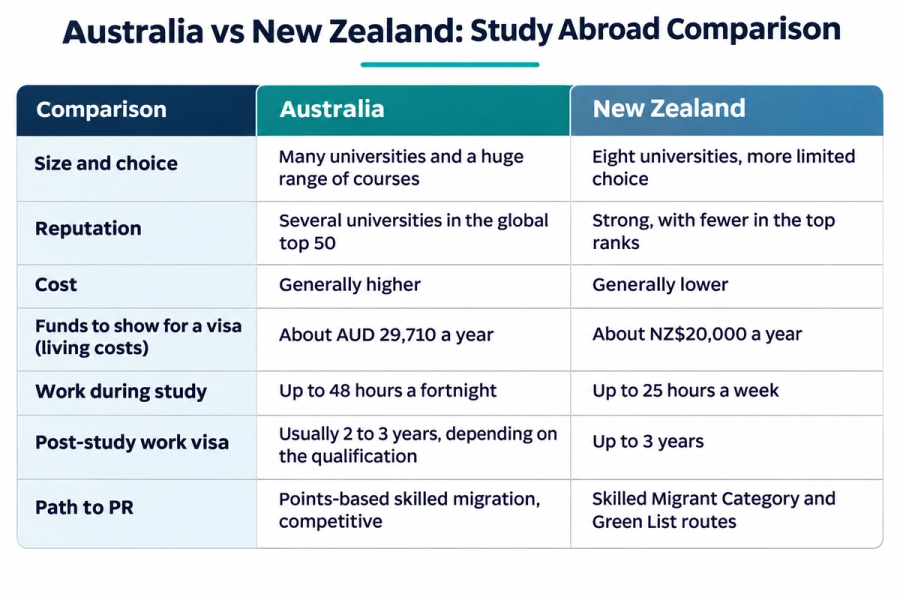
Here's a quick comparison. Treat it as a starting point, because fees and rules change often.
Universities and Course Choice
Australia has a much larger higher-education sector, with a group of research-intensive universities, often called the Group of Eight, that rank well globally. That means more options if you want a specific specialisation, a particular city or a highly ranked name.
New Zealand has just eight universities, so there are fewer choices, but all eight are recognised internationally and class sizes can feel smaller and more personal. For many courses, such as nursing, engineering, IT and agriculture, you'll still find strong programmes.
If you already know your subject, the better question isn't "which country?" but "which course and which university?". Our guides to trending courses in Australia and the best courses in New Zealand can help you think that through.
Cost: Where New Zealand Usually Wins
For most students, New Zealand works out cheaper. Tuition for comparable programmes tends to be lower, and living costs outside Auckland are often easier on the budget. Australia's big cities, especially Sydney and Melbourne, can be expensive, and its visa requirements involve higher upfront costs.
A few points to keep in mind. The living-cost funds you must show for a visa are higher for Australia (around AUD 29,710 a year) than for New Zealand (around NZ$20,000 a year). Visa application fees have risen in both countries recently, and published figures differ between sources, so always check the official government sites before you budget. And whichever country you choose, city matters. Studying in a regional area can cut your costs significantly in either country.
If you're planning to borrow, our basics guide to education loans for studying abroad is a good place to start.
Working While You Study
Both countries let you work part-time during term and full-time during official breaks, and the numbers are broadly similar. Australia allows up to 48 hours per fortnight, which is roughly 24 hours a week. New Zealand raised its limit to 25 hours per week from November 2025.
Part-time work can help with living costs, but it rarely covers tuition, so don't plan your finances around it. Your studies should come first, and breaking work conditions can put your visa at risk in either country.
Staying On After You Graduate
This is where the two countries start to differ. Both offer a post-study work visa that lets you work for most employers while you look for a skilled job.
Australia has the Temporary Graduate visa (subclass 485). The length depends on your qualification. Bachelor's and coursework master's graduates generally receive around two years, while research degrees can get longer. Some sources also mention extra time for Indian graduates under a trade agreement, but that can change, so confirm the current position with the official website. Age limits also apply for this visa.
New Zealand has the Post-Study Work Visa, which can run up to three years depending on your qualification level. New Zealand has also announced a shorter graduate work visa for some qualifications, with changes coming in from mid-November 2026. Our guide to studying in New Zealand for Indian students gives more detail.
Both countries have changed these rules recently, and fees for post-study visas have gone up, so treat anything you read online (including here) as a starting point and check the official sites for the latest.
Permanent Residency: Different Systems, Different Risks
Neither country guarantees PR after your studies. But they work differently.
Australia uses a points-based system for skilled migration, plus state nomination and employer-sponsored routes. The system rewards factors such as occupation, age, English and work experience. Competition can be intense for popular occupations, and invitation scores can be high, so your choice of course matters a lot. We explain this in our trending courses in Australia guide.
New Zealand has a Skilled Migrant Category, and it also has a Green List of occupations in shortage. Some of these, such as certain nursing, engineering and teaching roles, can lead to residence more directly once you qualify and find a suitable job. For people in those fields, the route can feel clearer and quicker. But if your career isn't on that list, the path looks more like the general points system.
In short, New Zealand can be more predictable if your profession is on the Green List. Australia offers a bigger job market, but the pathway can be more competitive. For nursing specifically, you can read our posts on nursing in Australia and MSc nursing in New Zealand.
Jobs and Lifestyle
Australia's economy is much larger, with more employers and a bigger range of industries, especially in Sydney, Melbourne, Brisbane and Perth. If you want a lot of choice, a big city feel and a larger Indian community, Australia may suit you.
New Zealand is quieter and smaller. Cities are easier to get around, nature is on your doorstep, and many students describe it as relaxed and safe. The trade-off is a smaller job market, and some industries have fewer openings.
Neither lifestyle is better. It depends on what you want from the next few years.
The Visa Process
Both countries ask you to prove that you have an offer from an approved institution, enough money, health cover and genuine intent to study. Australia's process has become more detailed in recent years, including a Genuine Student assessment, and some applicants face closer checking. New Zealand's process is often described as simpler, but you still need complete, honest documents either way. If you're considering Australia, our guide to the basic requirements for studying in Australia explains the essentials.
So, Which Should You Choose?
Australia may be a better fit if you want a wider choice of courses and universities, a bigger job market, and you're comfortable with higher costs and a more competitive migration system.
New Zealand may be a better fit if you want lower costs, a quieter lifestyle, and your profession is on the Green List or you value a clearer route to residence.
Whichever you choose, pick the course first. The right course at the right university in the right country will always beat a "better" country with the wrong course.
Mistakes to Avoid
- Choosing a country before a course. Your subject and career goals should lead.
- Comparing only tuition. Look at living costs, visa costs and post-study options together.
- Relying on old blog posts. Rules and fees changed in both countries recently.
- Assuming PR is guaranteed. It isn't, in either country.
- Ignoring your own profile. Your age, grades, English score and budget all matter.
- Leaving it too late. Applications and visas take time in both countries.
Need More Than the Basics? Talk to Cliftons Study Abroad
This guide only covers the basics. Choosing between New Zealand and Australia depends on your course, your budget, your age and your long-term goals, and a wrong choice can be expensive. Which country suits your profile, which universities are realistic, and how each visa and post-study route applies to you are all things a counsellor can help you think through.
At Cliftons Study Abroad in Kochi, we help students across Kerala compare destinations, shortlist courses and universities, and manage applications and visas. If you'd like personal guidance, our counsellors are ready to help.
Can't decide between New Zealand and Australia? [Contact Cliftons Study Abroad today for a free consultation.]