
If you're planning to study abroad, you've probably already heard the three names that come up again and again: IELTS, PTE and TOEFL. Your friends have strong opinions about them. Your cousin swears by one. A YouTube video says the other is "easier."
The truth is that none of them is simply "the best." Each one is built a little differently, and the right choice depends on where you're applying, how you like to be tested and how much time you have. This guide covers the basics in plain language so you can narrow it down. It's written in November 2026, and test rules change, so always check the official websites. If you'd like advice for your own situation, Cliftons Study Abroad is happy to help.
What Do These Tests Actually Do?
All three tests measure the same four skills: listening, reading, writing and speaking. Universities and immigration departments use your scores to check that your English is strong enough to handle your course and daily life abroad. You won't "pass" or "fail" any of them. You simply get a score, and the university or visa sets the score it needs.
The Three Tests at a Glance
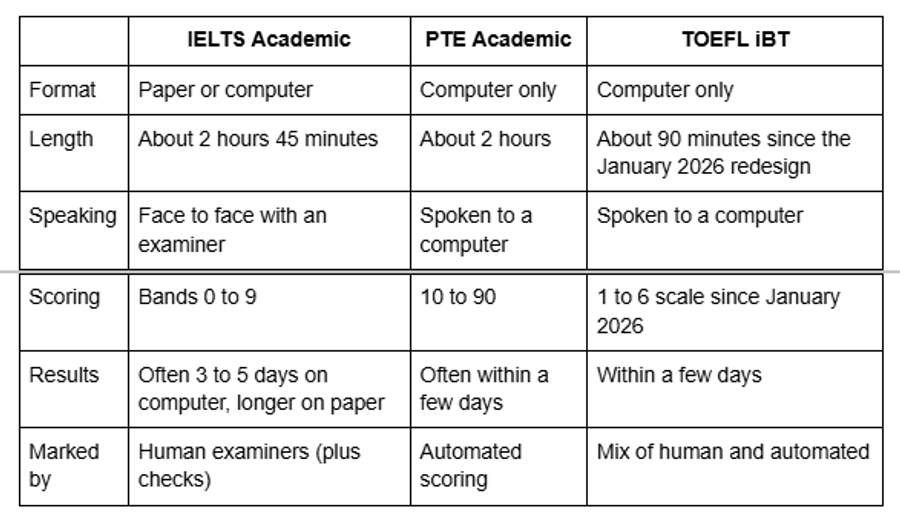
Here's a simple side-by-side look. Details can change, so treat this as a starting point.
IELTS in a Nutshell
IELTS is the most widely recognised of the three, and many Kerala students choose it. You can take it on paper or on a computer. The big difference from the others is the speaking test: it's a short, one-to-one conversation with a real examiner, which some people find friendlier and others find more stressful.
Often a good fit if: you're applying to the UK, you'd rather speak to a person than a microphone, or you want the test with the widest acceptance.
Worth knowing: For UK student visas you generally need a specific approved version of the test, often called IELTS for UKVI, so check this before you book. Paper-based results can take longer.
PTE Academic in a Nutshell
PTE is fully computer-based and automatically scored, which means no examiner judging your accent or mood on the day. Results often come back quickly, sometimes within a couple of days, and test dates are frequent. The test mixes skills together, so one answer might check both your speaking and your listening.
Often a good fit if: you're comfortable with computers, you get nervous speaking to an examiner, or you're on a tight deadline.
Worth knowing: The question types are different from what most students are used to, so you'll need to practise the format, not just your English. Acceptance is strong for Australia and New Zealand and still growing elsewhere, but check whether your specific university and visa accept it.
TOEFL iBT in a Nutshell
TOEFL has traditionally been the favourite for the USA, though it's accepted in many other places too. It changed a lot in January 2026. The test is now shorter, at around 90 minutes, parts of it adapt to your level as you go, and the old 0 to 120 total has been replaced by a 1 to 6 score band. Some universities are still publishing how they convert the new scores, so check what they accept.
Often a good fit if: you're applying to universities that specifically ask for it, especially in the USA, and you're comfortable with a computer-based academic test.
Worth knowing: TOEFL is generally not accepted as proof of English for UK student visas, even if some UK universities accept it for admission. And because the scoring changed recently, old comparison charts may be out of date.
How Do the Scores Compare?
People often ask what an IELTS score is "worth" in the other tests. Here's a rough guide for the two tests with long-standing scales. It's only approximate, and universities and immigration departments set their own requirements, so never rely on a conversion chart alone.
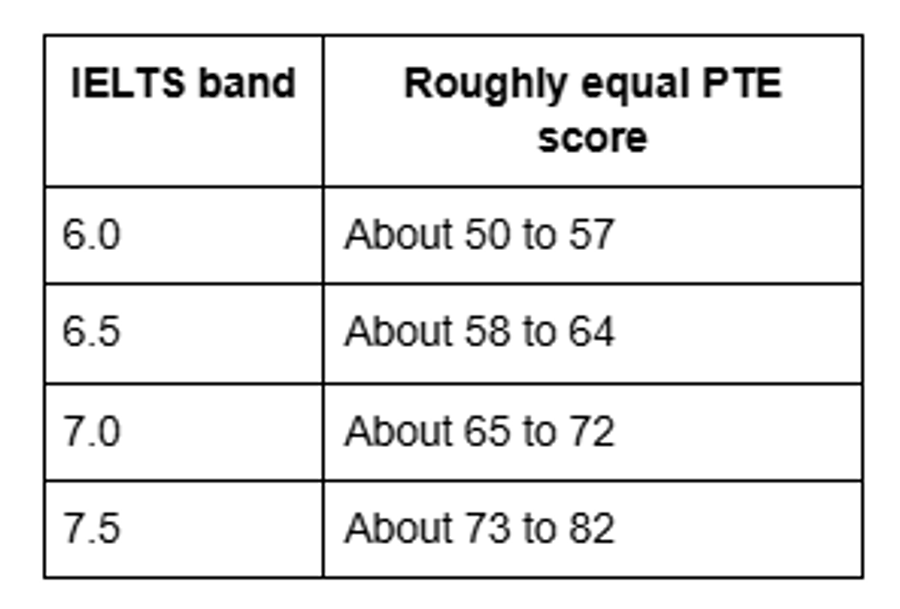
For TOEFL, the new 1 to 6 scale is still bedding in, so ask the university directly what score it needs, rather than trusting a chart you found online.
Which Test Do Your Destination and University Accept?
This is the most important question, and it's easy to get wrong. Acceptance depends on both the university and the visa.
UK. Universities often accept several tests, but the visa side is stricter. UK student visas generally need an approved test version, so check the official list. TOEFL isn't accepted for this purpose. See our guide to the best universities in the UK for Indian students.
Ireland. IELTS is widely accepted, and many universities also accept PTE and TOEFL, but it varies by course. Always check the specific programme page.
Germany. Many English-taught programmes accept IELTS and TOEFL, and some accept others. Check each programme, since requirements differ.
Australia. The visa accepts all three major tests, and PTE is popular because of its fast results. Universities set their own requirements, which can be higher than the visa's. See our guide to the basic requirements for studying in Australia.
New Zealand. IELTS and PTE are the usual choices. Check your university and course.
USA and Canada. The USA often asks for TOEFL, though many accept IELTS or others. Canadian rules depend on the route and institution, so confirm which tests count.
A simple rule: before you pay for any test, check the exact requirement on the university's course page and, where relevant, the official visa website.
How to Choose: Five Simple Questions
1. What does your university and visa accept? This overrules everything else. If only one test is accepted, the decision is made.
2. How do you feel about speaking? If a real person across the table helps you, IELTS may suit you. If talking to a microphone is more comfortable, PTE or TOEFL may be better.
3. How comfortable are you with computers? PTE and TOEFL are fully computer-based. IELTS lets you choose paper or computer.
4. How much time do you have? If your deadline is close, check how quickly each test reports results and how soon you can get a test date near you.
5. How do you write and read under pressure? Different tests reward different strengths, so try a practice test of each and see which feels more natural.
If you're a nurse, remember there's also the OET, which is built around healthcare communication and is accepted by many nursing regulators and some universities. Check whether it's accepted for your course.
Costs, Booking and Validity
Test fees are broadly similar across the three, usually in the range of roughly ₹15,000 to ₹20,000 in India, though they change often and differ by test type, so check the official booking page. Scores are generally valid for about two years, which matters if you plan to apply many months before you travel. Book early, because popular test dates and centres in Kerala can fill up.
Preparing the Smart Way
- Know the format. Take a full practice test under timed conditions before you book.
- Practise your weakest skill. Most people have one section that drags down their overall score.
- Check each skill minimum. Some universities and visas require a minimum in every skill, not just an overall score. A strong overall result can still fall short if one section is too low. Our guide to common student visa rejection reasons explains why this matters.
- Aim above the minimum. Give yourself a buffer, not just the bare requirement.
- Leave time for a retake. If you need a second attempt, you don't want to be rushing.
Common Mistakes to Avoid
- Picking a test because a friend did. Your destination and university may need something different.
- Booking before checking acceptance. An unaccepted test is a wasted fee.
- Ignoring section scores. Overall scores can hide a weak skill.
- Using old information. TOEFL changed in 2026, and other rules shift too.
- Taking the test too early or too late. Validity and deadlines both matter.
- Not practising the format. Even strong English speakers can lose marks on unfamiliar question types.
Need More Than the Basics? Talk to Cliftons Study Abroad
This guide covers the basics only. The right English test depends on your destination, your university, your course and your own strengths, and a wrong choice can waste time and money. Which test your course accepts, what score you realistically need, and how to fit your test date around applications and visa timelines are all things a counsellor can help you work out.
At Cliftons Study Abroad in Kochi, we help students across Kerala choose courses and universities and manage applications and visas, including working out which English test fits their plans. If you'd like personal guidance, our counsellors are ready to help.
Not sure which English test to take? [Contact Cliftons Study Abroad today for a free consultation.]