When Kerala students think of France, they often picture Paris, famous business schools and expensive fees. But France is also home to a large network of public universities where the tuition is far lower than in many other popular study destinations. That's why more than 400,000 international students now study there.
There's one important catch, and it changed recently. In 2026/27, France tightened the rules on fee exemptions, so most new non-EU students now pay the full international rate. It's still affordable compared with many countries, but it isn't free. This guide covers the basics: what "affordable" really means in France, what you'll pay, and how to choose sensibly. It's written in November 2026, and details change, so always check official sources. If you'd like advice for your own situation, Cliftons Study Abroad is happy to help.
Public Universities vs Business Schools: The Big Difference
This is the first thing to understand, because it decides your budget.
Public universities are funded by the state and charge low, regulated fees. They offer bachelor's, master's and doctoral degrees in almost every subject. This is where most affordable options are.
Business schools and private institutions set their own fees, and these can be much higher. Well-known business schools offer excellent programmes, but they sit at a very different price level. Our guides to business courses in France and management courses in France explain that side of the picture.
If affordability is your priority, public universities are usually the place to start.
What Do Public Universities Charge in 2026/27?
France uses a system of "differentiated fees" for students from outside the EU, the European Economic Area and Switzerland. Here's the broad picture, based on recent sources. Figures are set each year and sources differ slightly, so confirm the exact amount with your university.
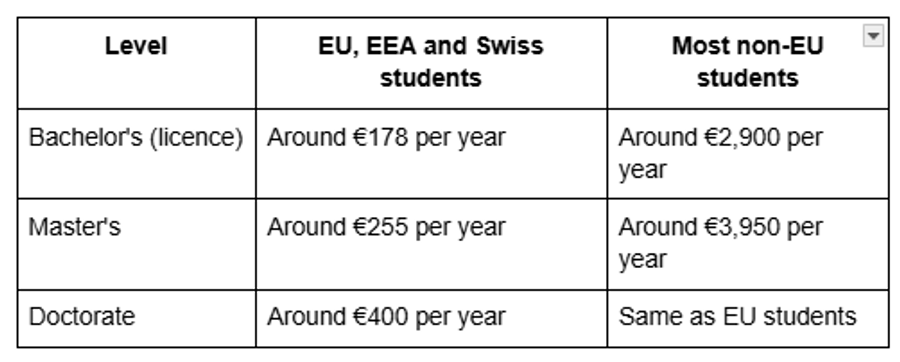
On top of tuition, every student pays a small student-life contribution called the CVEC, which is around €105 a year and must be paid before you enrol.
For comparison, that's a fraction of what many universities in other major study destinations charge. It's why France is often described as one of the more affordable options for quality education.
The 2026 Change You Need to Know About
For years, many French universities chose to waive the higher international fee, so non-EU students paid the low EU rate. That made France look almost free. From 2026/27, a new rule limits how many students universities can exempt, so most new non-EU students now pay the full differentiated rate.
Some sources say a university can still exempt up to roughly 30 percent of its non-EU students, but the details are still being explained, so don't count on getting an exemption. Treat the standard rate as your budget, and consider any waiver a bonus. Older blog posts that say "France is nearly free" may be out of date.
What Does "Affordable" Include? The Full Picture
Tuition is only part of the cost. When you work out your budget, add:
- Living costs. Rent, food, transport and daily expenses. These are the biggest part of your budget.
- The CVEC contribution. Around €105 a year.
- Health insurance. Students are generally covered through the French system, but rules vary, so check.
- Visa and application costs. This includes an application fee through Campus France's "Études en France" process for students from India, and visa fees.
- Proof of funds for the visa. The monthly amount you need to show has been rising, with a figure of €877.50 a month cited for 2026, so confirm the current requirement.
- Flights and settling-in costs.
If you plan to borrow, our basics guide to education loans for studying abroad is a good place to start.
Where to Save: Choosing a Cheaper City
Where you study affects your costs as much as the fee does. Paris is the most expensive city in France by a big margin. Many students find that cities such as Lille, Strasbourg, Toulouse, Lyon, Montpellier and Aix-Marseille are noticeably cheaper for rent and daily life, while still offering strong public universities. The tuition fee is the same regulated rate across public universities, so choosing a more affordable city is one of the simplest ways to keep your budget down.
Student housing through the state student services (CROUS) can be cheaper than private rentals, though places are limited and demand is high, so apply early.
Affordable Universities: What to Look For
Rather than hunting for a "cheapest university" list, think about what makes a university affordable for you.
A public institution. The state sets the fees, so they're predictable.
A cheaper city. This lowers your biggest ongoing cost.
A programme taught in a language you can manage. This is a big one, covered below.
Scholarship access. Some universities and regions offer funding for international students.
Good support for international students. Help with housing, paperwork and orientation saves both time and money.
Universities in cities such as Lille, Strasbourg and Aix-Marseille are often mentioned as affordable choices, but always confirm details on each university's own website, because fees, exemptions and English-taught programmes change.
The Language Question
This is the most important point for many Kerala students. A large share of public university courses, especially at master's level, are taught in French. English-taught programmes exist, but they're a smaller part of the offering and can be more competitive.
If you don't speak French, you have three realistic options: look specifically for English-taught programmes, plan to learn French to the required level before you start, or consider a different destination. Even in English-taught courses, some French makes daily life and administration much easier. Check each course's teaching language and any French requirement before you apply.
Basic Entry Requirements
Requirements vary by university and level, but you'll usually need:
- Academic qualifications. For bachelor's study, your Class 12 results; for master's, a relevant bachelor's degree with the grades the university asks for. Many Indian degrees are three years long, so check each course's rules.
- Language proof. French test results for French-taught courses, or English proof for English-taught ones. See our guide to IELTS vs PTE vs TOEFL for the English side.
- Campus France application. Applicants from India usually apply through the Campus France "Études en France" platform before the visa stage. Some sources mention a fee of INR 20,000 for 2026/27, so confirm this.
- Supporting documents. A motivation letter, CV, transcripts and references.
Scholarships and Funding
A few options are worth knowing about at a basic level. The Eiffel Excellence Scholarship is highly competitive and is handled through institutions. The Charpak scholarship is aimed at Indian students. Some regions and universities offer their own awards, and individual institutions may offer fee reductions. Funding is usually competitive and deadlines can be early, so look at scholarship pages as soon as you shortlist universities.
Intakes and Timing
Most public university programmes start in September, and the application process begins many months earlier, often in the autumn or winter before. Because there's a Campus France stage, a French test if needed, and visa processing, it's wise to start your planning at least a year ahead.
Common Mistakes to Avoid
- Assuming France is free. Non-EU students now pay differentiated fees, plus other costs.
- Relying on old blog posts. Fee rules changed for 2026/27.
- Ignoring the language. Many courses are taught in French.
- Choosing Paris by default. Other cities can save you a lot.
- Comparing only tuition. Add up living costs, insurance and visa costs.
- Applying too late. The process has several stages.
- Confusing public universities with business schools. Their costs are very different.
Need More Than the Basics? Talk to Cliftons Study Abroad
This guide only covers the basics. Choosing an affordable university in France depends on your course, your language ability, your marks and your budget, and a wrong choice can cost time and money. Which universities are realistic for your profile, which programmes are taught in English, and how to plan your Campus France application and timeline are all things a counsellor can help you work out.
At Cliftons Study Abroad in Kochi, we help students across Kerala compare courses and countries, shortlist universities and manage applications and visas. If you'd like personal guidance, our counsellors are ready to help.
Looking for an affordable university in France? [Contact Cliftons Study Abroad today for a free consultation.]