
Artificial intelligence has moved from a niche subject to one of the most talked-about fields in the world, and it's easy to see why so many students from Kerala want to study it abroad. But if you start searching, you'll find a confusing pile of course names, rankings and country comparisons. Which course is actually right? Which country makes sense for your budget?
This guide keeps things simple. It covers the main types of AI and machine learning courses, the countries that stand out, what you'll usually need to apply, and the mistakes to avoid. It's the basics only, written in October 2026. For advice that fits your own situation, Cliftons Study Abroad is happy to help.
What Do "AI and Machine Learning Courses" Actually Include?
The names vary, and that's part of the confusion. Here are the main types you'll come across.
MSc in Artificial Intelligence is broad. You'll typically study machine learning, deep learning, natural language processing, computer vision and the ethics of AI.
MSc in Machine Learning goes deeper into the maths and algorithms behind learning systems, and it tends to be more technical.
MSc in Data Science (sometimes called Data Science and AI) combines statistics, programming and machine learning applied to data. It's a popular, flexible choice.
AI and Robotics, or applied AI programmes focus on real-world use, such as automation, healthcare, finance or business.
Two courses with similar titles can be very different, so always read the module list. A course called "AI" at one university might be mostly theory, while another is heavily practical.
Which Countries Are Best for AI in 2027?
Several countries consistently come up as strong for AI study: the USA, UK, Canada, Germany, Australia and Singapore, with Ireland, the Netherlands, France and Switzerland also doing well. Because Cliftons works mainly with students heading to the UK, Ireland, Germany, Australia and similar destinations, here's a quick comparison of those.
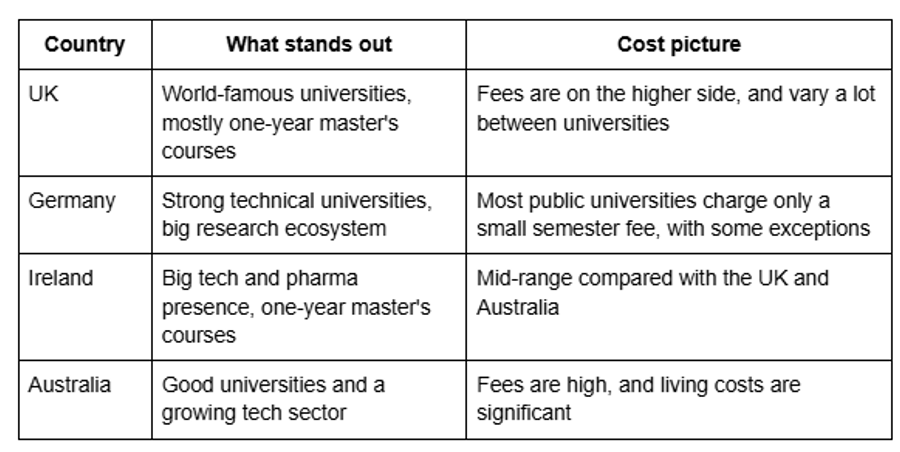
These are broad impressions, not promises. Fees change every year, so always check each university's own page for your intake.
The UK: Famous Names and Short Courses
The UK offers specialised AI, machine learning and data science master's programmes at universities such as Imperial College London, Oxford, Cambridge, UCL and Edinburgh, among many others. Most taught master's courses take just one year, which keeps total time and living costs down. A recent change is worth knowing about: the Graduate Route visa is being shortened from two years to 18 months for applications from 1 January 2027, so plan for the shorter period if you're starting in 2027. You can read more about UK universities in our guide to the best universities in the UK for Indian students.
Germany: Strong Tech, Low Fees
Germany is popular with students who want a technical education without large tuition bills. Many public universities, such as the technical universities in Munich, Aachen and Karlsruhe, charge only a modest semester fee, usually somewhere between about €100 and €400, though a few institutions and states charge non-EU students tuition. Germany also has a serious AI research scene. The paperwork is heavier than in some countries, and some courses expect a strong maths and programming background, so start early. We explain this in more detail in our guide to computer science, AI and data science in Germany.
Ireland: Big Tech, One-Year Courses
Ireland is home to the European operations of many global technology companies, and it offers one-year master's programmes in AI, data science and analytics at universities such as Trinity, UCD and DCU. Fees generally fall between the UK and Germany, and master's graduates can usually use the Stay Back option to look for work after studying. Our guide to the MSc in data analytics in Ireland covers a closely related course.
Australia: Strong Universities, Higher Costs
Australian universities such as Melbourne, Monash, UNSW and Sydney offer well-regarded AI and related programmes, and Australia's tech sector is growing. Tuition and living costs are significant, and visa rules have been changing, so budget carefully. See our guide to the basic requirements for studying in Australia for the essentials.
What Do You Usually Need to Apply?
Requirements differ by university, but most AI and machine learning master's programmes look for the following.
A relevant bachelor's degree. Computer science, information technology, electronics, mathematics, statistics or engineering are the usual backgrounds. If you come from a different field, some universities offer conversion courses, but entry can be harder.
Good grades. Competitive universities ask for strong marks, and the minimum varies.
Programming and maths skills. Python is the most common language, and you'll usually need a good grasp of linear algebra, probability and statistics. Many universities look for this in your transcripts or a short test.
English proof. Usually IELTS or a similar test, with scores depending on the course.
Supporting documents. A statement of purpose, references and often a CV. Some applicants strengthen their profile with projects, internships or online coursework.
GRE. Many UK, Irish, German and Australian universities don't require it, though US universities often do. Check each course page.
Choosing the Right Course for You
A few simple questions can save you a lot of trouble.
What do you want to do afterwards? If you want to build and train models, a technical machine learning course suits you. If you're more interested in using AI inside a business, an applied or data-focused programme might be better.
What's your background? A course should match your maths and coding level. Choosing one that's far too hard, or far too easy, doesn't help.
What's your budget? Compare tuition, living costs and the length of the course, not just the headline fee. If you plan to borrow, our basics guide to education loans for studying abroad is a good place to start.
Where do you want to work later? Post-study work rules and job markets differ by country, so think about this before you pick a destination.
Is the course practical? Look for projects, industry links, placements or a dissertation with a real-world problem.
Careers After an AI or Machine Learning Degree
Graduates commonly work as machine learning engineers, AI engineers, data scientists, data analysts, research scientists and software engineers. Industries range from technology and finance to healthcare, manufacturing and consulting. AI is also changing quickly, so employers value people who can keep learning, not just people who know today's tools. Salaries vary hugely by country, employer and experience, so check current figures for the market you're aiming at rather than trusting generic numbers.
Common Mistakes to Avoid
- Choosing by buzzword. A course with "AI" in the title isn't automatically a good one. Read the modules.
- Ignoring your maths and coding level. Many programmes expect a solid technical foundation.
- Looking only at fees. Living costs, course length and post-study options all matter.
- Applying only to top names. Competitive universities turn down many strong applicants.
- Using old information. Rankings, fees and visa rules change every year.
- Starting too late. Applications, offers and visas take time, so begin early.
Need More Than the Basics? Talk to Cliftons Study Abroad
This guide only covers the essentials. Picking the best AI or machine learning course for you depends on your background, your grades, your budget and where you want to build a career. Which universities are realistic for your profile, how to strengthen your application, and how to plan around visas and post-study work are all things a counsellor can help with.
At Cliftons Study Abroad in Kochi, we help students across Kerala shortlist courses and universities and manage applications and visas for a range of study destinations. If you'd like personal guidance, our counsellors are ready to help.
Thinking of studying AI or machine learning abroad? [Contact Cliftons Study Abroad today for a free consultation.]

